Midlife Reinvention · Mindset
Overcoming Midlife Imposter Syndrome and Reclaiming Your Wisdom
Have you ever walked into a room, looked at your title, your track record, your years of experience, and still heard a quiet voice whisper: “You’re not good enough. One day they’ll find out you’re not as capable as they think.”
If that sounds familiar, you’re not alone. Many accomplished midlife professionals — managers, directors, founders, consultants — quietly battle midlife imposter syndrome. On paper, they look successful. Inside, they feel like they’re constantly one step away from being “exposed”.
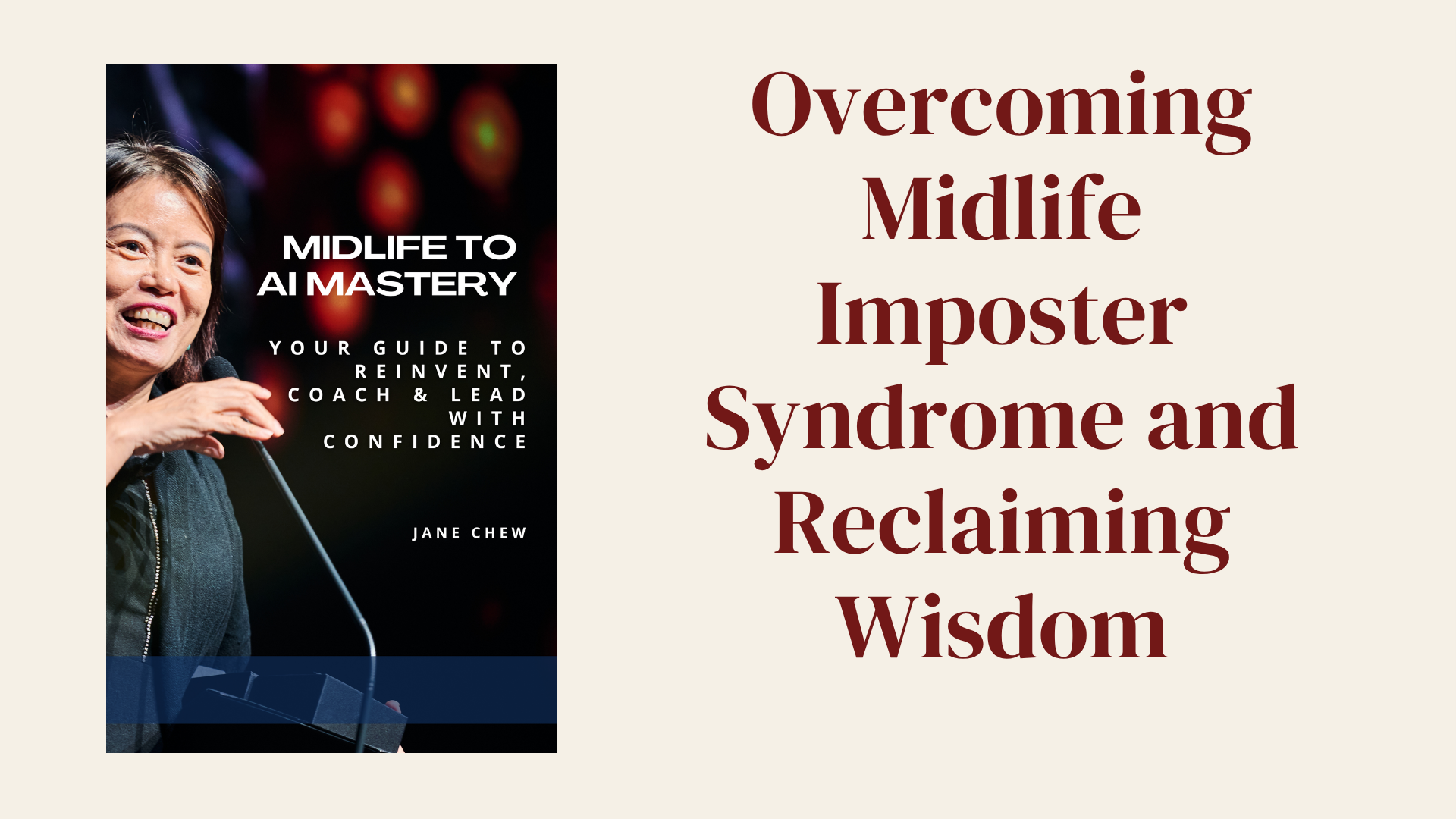
This article distils key ideas from Chapter 4 of my book, “Midlife to AI Mastery: Your Guide to Reinvent, Coach & Lead with Confidence”, and shows you how to recognise imposter syndrome, reclaim your wisdom, and turn self-doubt into meaningful contribution.
What Is Midlife Imposter Syndrome?
Imposter syndrome is the persistent feeling that your success is accidental or undeserved, and that at any moment someone will “find out” you’re not as competent as they think you are. At midlife, this often shows up precisely when your CV is the longest it has ever been.
In Chapter 4, I describe imposter syndrome not as a personal defect, but as a sign that you are:
- Stretching beyond your comfort zone
- Stepping into unfamiliar territory (new role, business, technology, or visibility)
- Holding yourself to a much higher standard than you hold others
In other words, feeling like an imposter does not mean you are incompetent. It usually means you are growing.
Why Your Midlife Wisdom Matters More Than Ever
Our world celebrates speed: speed of information, speed of decisions, speed of promotion. But speed without depth leads to shallow solutions and short-term thinking. This is where midlife professionals are uniquely powerful.
You carry:
- Context – You’ve seen cycles: booms, downturns, restructurings, and reinventions.
- Discernment – You’ve learned to filter noise from signal.
- Wisdom – You understand human behaviour, not just numbers and dashboards.
Chapter 4 reminds you that your wisdom is not “outdated”. It is the missing ingredient in a world obsessed with hacks, speed, and shortcuts. The question is no longer, “How do I keep up?” but rather, “How do I lead with the depth I already have?”
Shifting from Comparison to Contribution
One of the most powerful mindset shifts in overcoming imposter syndrome is moving from comparison to contribution.
When you compare, the focus is on:
- What others are doing
- What you haven’t achieved yet
- Your perceived gaps and shortcomings
When you focus on contribution, the lens changes to:
- Who you can help with what you already know
- What problems your experience can solve
- How your story and lessons can shorten someone else’s learning curve
A simple question to ask yourself is: “Who becomes better, faster, or wiser because I choose to share what I know today?”
The moment you shift into contribution, self-doubt becomes fuel: “I may not know everything, but what I know is enough to help someone right now.”
Naming Your Inner Critic to Transform Self-Doubt
Chapter 4 also introduces a practical technique: naming your inner critic. When that harsh inner voice speaks, it often sounds like “truth”. But it’s usually a scared part of you trying to keep you safe.
Try this:
- Give your inner critic a name (for example, “The Inspector”, “Miss Perfect”, or “The Fearful CFO”).
- When the voice appears, acknowledge it: “Thank you, Inspector, for trying to protect me.”
- Then respond as your wiser self: “Right now, my role is to serve, not to be flawless. I will take the next step anyway.”
By naming your inner critic, you create distance between who you are and what you’re feeling. The doubt becomes information, not identity.
Practical Steps to Start Reclaiming Your Confidence
Here are some simple, actionable steps you can start using immediately:
- Audit your wins: Make a list of projects, people, and organisations you’ve helped over the last 10–20 years.
- Write a “wisdom CV”: Instead of roles and titles, list lessons learned and patterns you can now see clearly.
- Help one person: Share a tip, framework, or story with someone who needs it. Let usefulness replace self-judgement.
- Limit comparison time: Set boundaries around social media and replace some scrolling with journaling or intentional learning.
Confidence is not built by thinking about doing. It’s built by doing — in small, consistent steps, aligned with who you want to become in this next season of life.
Where AI Fits In: Why Midlife Experts Are Still Needed
Many midlife professionals fear that AI and younger, tech-savvy talent will make them obsolete. In reality, AI amplifies the value of those who bring judgement, ethics, and context.
AI can:
- Generate options, but not choose what truly matters.
- Analyse patterns, but not fully understand organisational politics or human emotions.
- Summarise information, but not replace lived experience.
Your wisdom is the “operating system” that guides how AI and technology are used. The goal is not to compete with AI on speed, but to combine your depth with AI’s capabilities so you can lead, coach, and make better decisions in less time.
Next Steps: Deepen Your Reinvention Journey
If this resonates with you, Chapter 4 of my book goes deeper into handling midlife imposter syndrome, reframing your story, and turning your experience into a powerful platform for coaching, consulting, or leadership in the age of AI.
You’ll learn how to:
- Identify and rewrite limiting stories about age, relevance, and expertise
- Design a new identity as a midlife expert and mentor
- Use AI as a partner to amplify (not replace) your wisdom
If you’re ready to move from quiet self-doubt to confident contribution, this is your next step.
👉 Get the book: Midlife to AI Mastery: Your Guide to Reinvent, Coach & Lead with Confidence
Reflection Prompt
Take a quiet moment to journal or think about these questions:
- 💭 What lessons from your career have shaped your judgment and leadership?
- 🤖 How can AI help amplify your strengths rather than replace them?
- 🌉 Where can you position your experience as the bridge between wisdom and innovation?
Your next chapter isn’t about proving your worth — it’s about reclaiming your wisdom and leading with purpose in the AI era.
📘 Get your copy of Midlife to AI Mastery — and learn how to turn your experience into your competitive edge in the AI era.
FAQs on Midlife Imposter Syndrome
1. Is it normal to feel like an imposter even with 20–30 years of experience?
Yes. Many high-achieving midlife professionals feel this way, especially when they step into new roles, industries, or technologies (like AI). The feeling of being an imposter often appears when you are growing, not when you are failing.
2. How do I know if it’s imposter syndrome or if I really need more skills?
A simple check: are you constantly learning and still feeling “never enough”? That points to imposter syndrome. It’s healthy to upgrade your skills, especially in digital and AI, but your decades of experience are still valid. You can learn new tools while honouring the wisdom you already have.
3. Can imposter syndrome ever fully disappear?
For most people, it doesn’t disappear completely — but it becomes quieter. With awareness and practice, you learn to recognise the voice of doubt more quickly and act from your wiser self instead of letting fear drive your decisions.
4. How can I start reclaiming my confidence today?
Start small: write down your wins, help one person with your expertise, and notice when perfectionism or procrastination is hiding fear. You don’t need a full reinvention overnight; you just need to move one step closer to the person you want to become.